
KEEP YOUR STRATEGY, KEEP YOUR TOOLS
Run energy operations as one system
Built around three core strengths
How Fusebox removes operational friction
- Connect assets, EMS, trading tools, and external systems through an open integration layer.
- Standardize execution across your architecture while preserving your existing operating model.
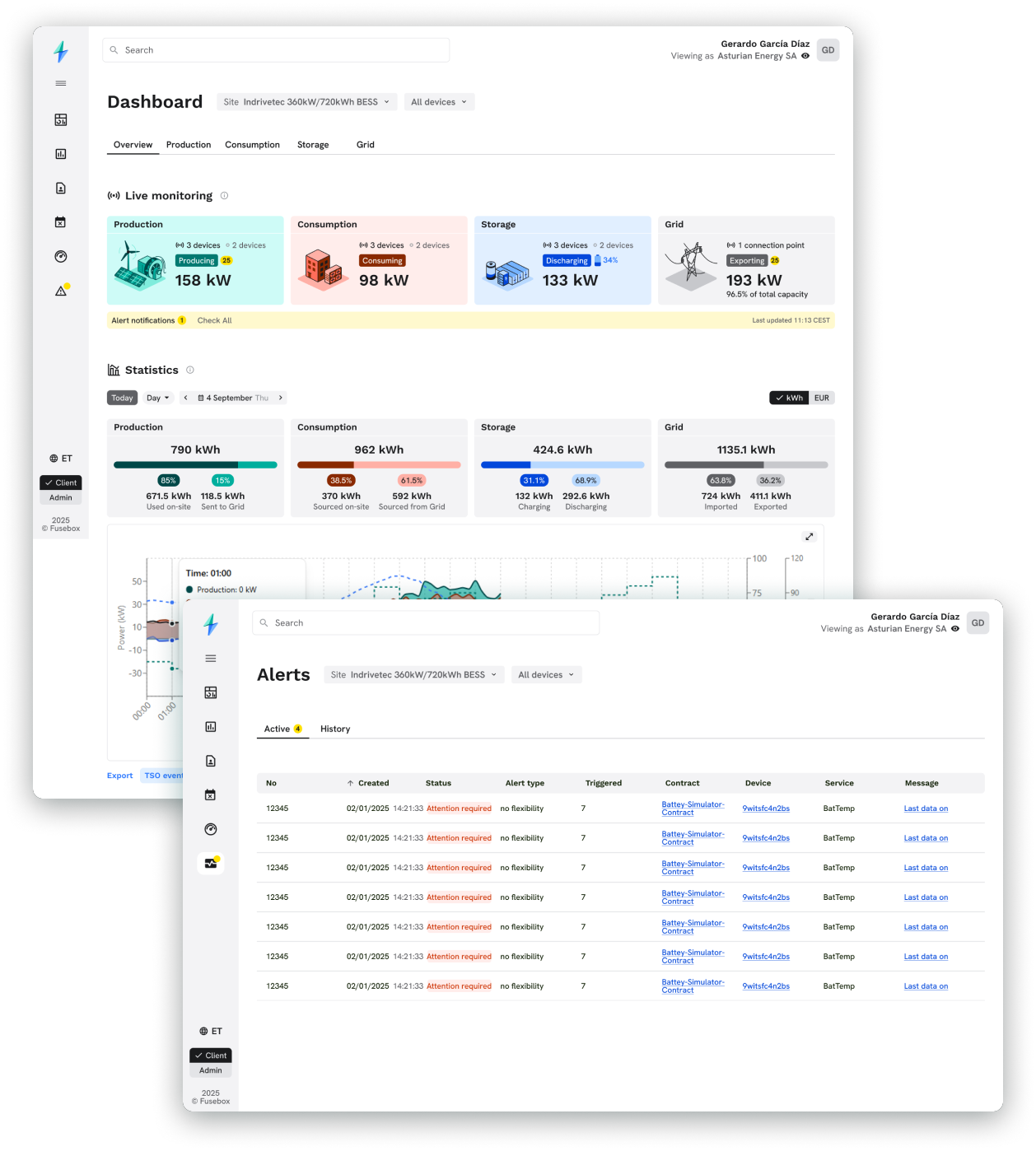
- Run real-time site control and dispatch through a single coordinated layer
- Orchestrate portfolios with clear availability, constraints, and activation logic
- Turn diverse assets into reliable, market-ready capacity
- Standardized bidding, activation, and reporting across TSOs
- Execution logic aligned with market requirements and compliance
- Audit-ready outputs for settlement and performance analysis
- Add sites, partners, TSOs, and markets without multiplying systems
- Expand capacity and geographic reach through repeatable execution patterns
Getting to the first MW live typically takes weeks to months, not quarters.
- Time to production: Weeks–months (vs 4–12 months with a single-vendor platform, or 9–30 months for an in-house build)
- Upfront investment: €0.05–€0.6M for onboarding and integrations (vs €0.3–€2.5M single-vendor, or €1.2–€5M in-house build)
- Operating costs: €0.1–€0.6M/y (vs €0.8–€3.0M/yr single-vendor, or €0.8–€4.5M/yr build)
Ranges vary based on your starting stack, asset mix, and target markets.
Business outcomes
Faster ancillary launch across new TSOs without bespoke reintegration
Scale MW and markets without scaling ops headcount (fewer systems, fewer handoffs)
Lower delivery risk with standardized execution and fewer operational errors
Keep optionality swap modules without re-platforming
FAQ – Frequently asked questions
Fragmentation creates structural inefficiencies beyond software fees. Disconnected control, trading, and TSO workflows increase coordination overhead, slow execution, raise imbalance exposure, and make scaling dependent on more systems and more people.
Fusebox OS is built for professional energy teams managing flexible portfolios across assets and markets — including BRPs, BSPs, utilities, traders, and aggregators.
Running operations as one system means control, portfolio orchestration, and market workflows operate through a unified layer. Teams gain consistent telemetry and command behavior across assets, portfolio-level dispatch logic in one place, standardized bidding and activation processes, and clear operational visibility from dispatch decisions to market outcomes.
No. Fusebox acts as a unifying operational layer across your existing systems, aligning control and market execution without restructuring your architecture.
Fusebox enables portfolio expansion through consistent control logic, bidding structures, and reporting standards across markets.
Time to first MW typically takes weeks to months, depending on your starting point. Commercial scope includes onboarding, integrations, subscription, and a small internal team (typically 1–3 FTE). Exact timelines and costs depend on portfolio complexity and target markets.
CO should include time to production, integration complexity, internal headcount, CAPEX exposure, and long-term scalability. A structured comparison clarifies the operational and financial trade-offs between integration layers, single-vendor platforms, and in-house builds.
The outcome is simpler operations today and a stack that scales tomorrow.